We’ll always have Paris

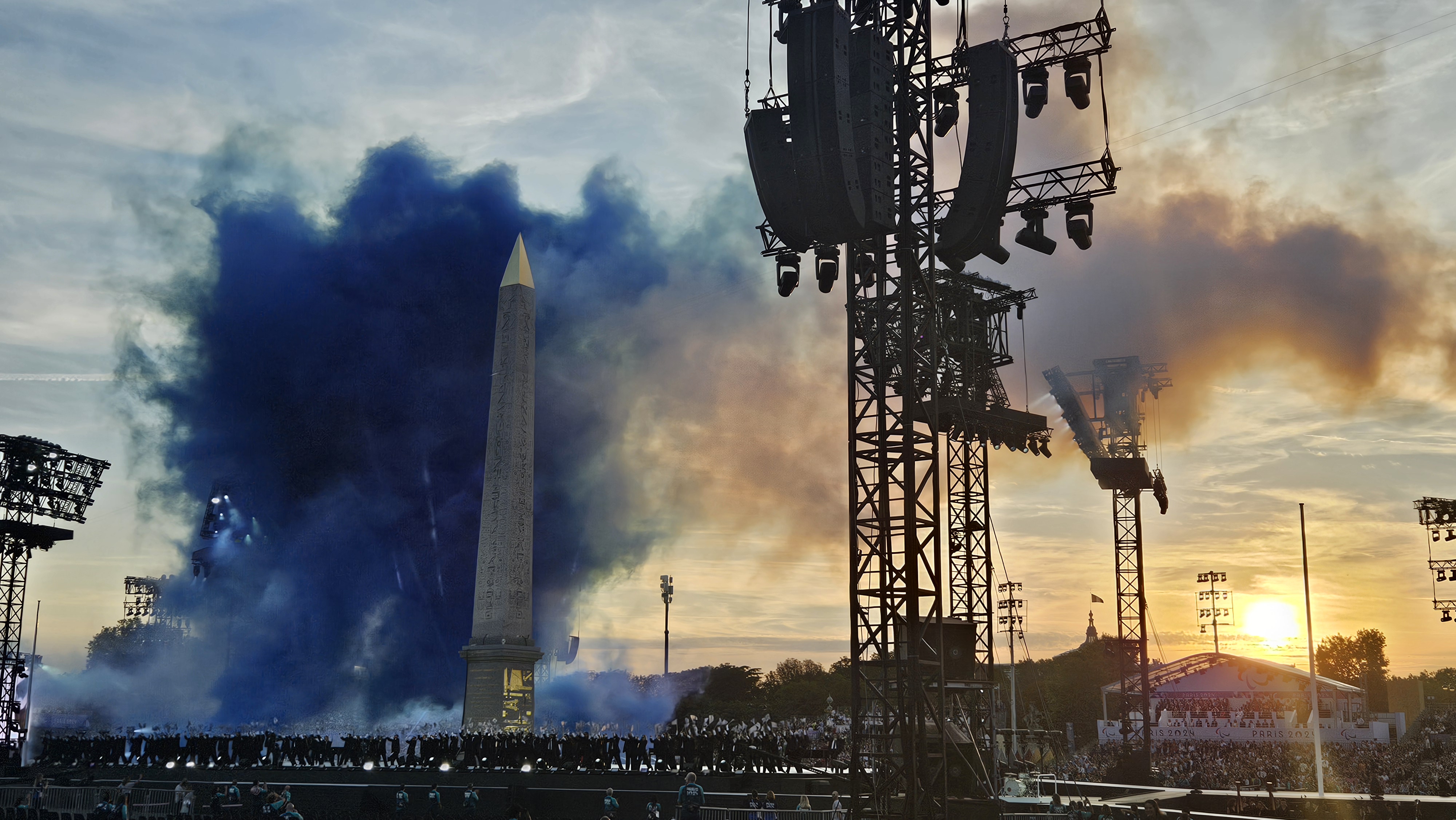
The Paris 2024 Paralympic Games were hailed as a return to sport, taking the spotlight at some of Paris’ most iconic landmarks, including the Eiffel Tower, the Chateau de Versailles and the Grand Palais. The opening ceremony would see the athletes parade through the iconic Avenue des Champs-Elysees to Place de la Concorde.

Over 4,000 Paralympians from around the globe would converge on Paris to compete in the first post-Covid Games, free of the restrictions of Tokyo and ready to show world the transformations and advancements they had made in the intervening 4 years. Nations, never before seen at the Paralympics would debut athletes in the 2025.

Paris, the city of love, welcomed the Paralympic Games with open arms. Parisians, often portrayed as rude and unfriendly to tourists, we able to release these shackles and embrace the athletes, teams and spectators alike.

Standing beneath the Eiffel Tower, strolling along the Seine, climbing the steps to the Basilique du Sacré-Cœur de Montmartre, exploring the alleys of Marché aux Puces de Saint-Ouen, viewing the Mona Lisa and Venus de Milo at the Louvre Museum or Napoleon’s tomb at Hôtel des Invalides complemented the athletic performances seen during the 10 days of the Games.

More Paralympic Records were broken at these Games. Paralympians defending their titles from Tokyo were beaten by virtual unknowns who were lifting the bar of performances, closing the gap between Para and Olympic achievement.

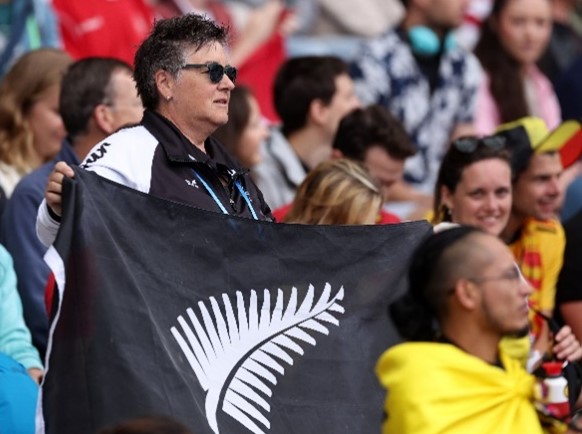
Being able to participate in the Games as a spectator, proudly wearing and waving the silver fern as the New Zealand athletes competed, was an absolute privilege. There is no comparison to experiencing the thrill of competition live. The splendor of the venues, the roaring and chanting of the crowd and the anticipation, nerves and relief as our Paralympians performed cannot be replicated while watching from afar.

Sharing this experience with my travelling companions and the New Zealand delegation was wonderful, but the wider camaraderie from those supporting other athletes from different nations is something which brings the Paralympic family together. No matter the colour of supporters gear, the celebration of Paralympic excellence transcended all. This is the magic of the Paralympic Movement, its more than just athletic performances which are celebrated, its the belief that through events like the Paralympic Games, the understanding of disability will be enhanced, the rights of disabled people will be improved and the lives touched by anyone with an impairment will be better for it.

The words of Andrew Parsons, President of the International Paralympic Committee, when opening the Games are resounding:

The Paris 2024 Paralympic Games will show what persons with disabilities can achieve at the highest level when the barriers to succeed are removed. Liberté! The right to live freely and without oppression. Egalité! Every person with a disability deserves the opportunity to thrive and live life free from barriers, free from discrimination and free from marginalisation.  Fraternite! We are one, but we are not the same. We are all from the same family, humanity. 

The Paris Paralympic Games set a new benchmark for disabled people, not only on the field of play but also on the expectations they take forward. I am optimistic the future for disabled people will improve, with sport playing a key role in making their lives better. I am proud to be part of the Paralympic Movement and be a champion of change here in New Zealand.
“I forget I have a disability”:

Understanding young peoples’ experiences in disability sport and active recreation in Aotearoa New Zealand.

This week, after 3 years and 11 days, I submitted by PhD thesis to the University of Waikato. It has been an amazing journey which allowed me to follow my passion as a practitioner into the academic realm. The abstract below from my thesis provides the outline of what I have researched and the findings.

The narratives of Quinn, Andrew, Gaby and Ella, corroborated by their parents and coaches/leaders, show the need for approaches underpinned by the principles of accessibility, flexibility and understanding, connecting practice to policy.

Abstract

In Aotearoa NZ, although 1 in 4 people identify as disabled, participation rates of YPwI in sport and active recreation is lower than their non-disabled peers. Over the last 80 years, the Aotearoa NZ Government has been aware of this disparity and has attempted through policy intervention to increase participation. However, the Aotearoa NZ sport system is inherently ableist and these policies have been ineffectual. Fortunately, opportunities for YPwI to participate in sport and active recreation do exist especially at the local club level.

Drawing on the social relational model of disability, I give agency to the voices of four young people with impairments (YPwI), their parents and coaches/leaders. Through their lived experiences in sport and active recreation, these participants present unique narratives on how participating with non-disabled young people have shaped the YPwI’s experiences. From their experiences, I sought to understand how sport organisations can improve opportunities for YPwI’s participation within a sport system dominated by ableism and where discrimination through disablism goes unchallenged.

The sport system, as a reflection of society, has a responsibility to address the inherent ableism endemic within sport and active recreation and reposition disability as a priority. Building on previous research focused on personal and societal barriers and constraints to participation, I challenge the dominance of activity adaptation and modification as a means for systemic change. To achieve an anti-ableist sport system, what is needed is more fundamental – an improved understanding of disability, flexibility around prescriptive ableist standards and rules, and increased accessibility to opportunities where YPwI can exhibit their capabilities. Integral to providing quality opportunities for YPwI, change in how the sport system considers and represents YPwI, from policy through to practice. I caution organisations to avoid enlightened ableism – where what is said and what is done are misaligned.

I present an anti-ableist framework, co-created with the YPwI, as a way of improving disability sport provision in Aotearoa NZ that enables the social relational model to be actualised within a sport and active recreation context. The framework presented encapsulates three levels – individual, organisation and system – premised on enhancing the knowledge and understanding of disability, creating more flexibility around what participation means to YPwI and how deliverers of sport and active recreation, regardless of size or capacity, can work individually and/or collaboratively to provide more opportunities for YPwI. 

I concluded my thesis with these final words from Ella, who advises YPwI to

be free just for yourself. Don’t like um, don’t worry about what other people think because that’s going to limit you […]. People should be able to accept us the way we are.

A journey of discovery

They all say doing a PhD is a journey of discovery – both about the topic you are researching and also of yourself.

I have been extremely fortunate throughout my journey to have the support of family and friends. All of whom have provided advice, guidance, motivation and enthusiasm at different stages. Many did not fully understand my research, but I did not expect them to., but just knowing they were there on my sideline, cheering me on was enough.

When I look back on my covid years, it has been filled with this journey, keeping me focused on something other than what was happening around me. Being preoccupied definitely had its advantages – I didn’t have to make excuses for not venturing out off my office. Not being able to meet and talk to my research participants was the big downside to it all, but with online chats I was still able to hear about their experiences in sport and active recreation and get a sense of how these young people with impairments are active and engaged and don’t let their impairments stop them. One day, I hope to meet them in person to thank them for their stories.

I have also come to appreciate what an amazing community we have here in NZ in Para sport and disability sport. Not getting caught up in the day-to-day grind does let you stop, breathe and reflect. People from all around the country, in different roles in different sports and activities are committed to providing opportunities for members of their communities to get out and get involved. It is because of many of these people that these young people are participating in sport and active recreation, and I was able to celebrate these successes – thank you.

It’s also interesting to look at how you as a researcher changes through the journey. Initially I was seeking to learn as much as possible from other researchers around the world to provide a framework for my work. Once I started hearing these stories and narrative about what is being done at grass roots sport and investigated what government agencies are trying to achieve through policy, I realised they do not always align. The challenge for me was to bridge this practice and policy gap and try to identify a solution. But its not as easy as it sounds. Working through this part of the research journey, pulling everything together is like doing a jigsaw puzzle without the outside pieces – you don’t always know how big the picture is and how fits together.

It is this picture building that I am now working on, pulling together all the insights I have gained from different sources, trying to make sense of it all. Ultimately, the plan is to provide guidance for those involved in delivering sport and active recreation for disabled young people to be better informed and have a better understanding of disability and impairment so the opportunities in the future will encourage more disabled young people to be involved.

Very much like one of my research participants shared,

I don’t think there’s ever been a part of me that’s wanted to stop swimming. So no one’s ever had to tell me to keep going with it […]. I don’t get pushed, but I get supported.

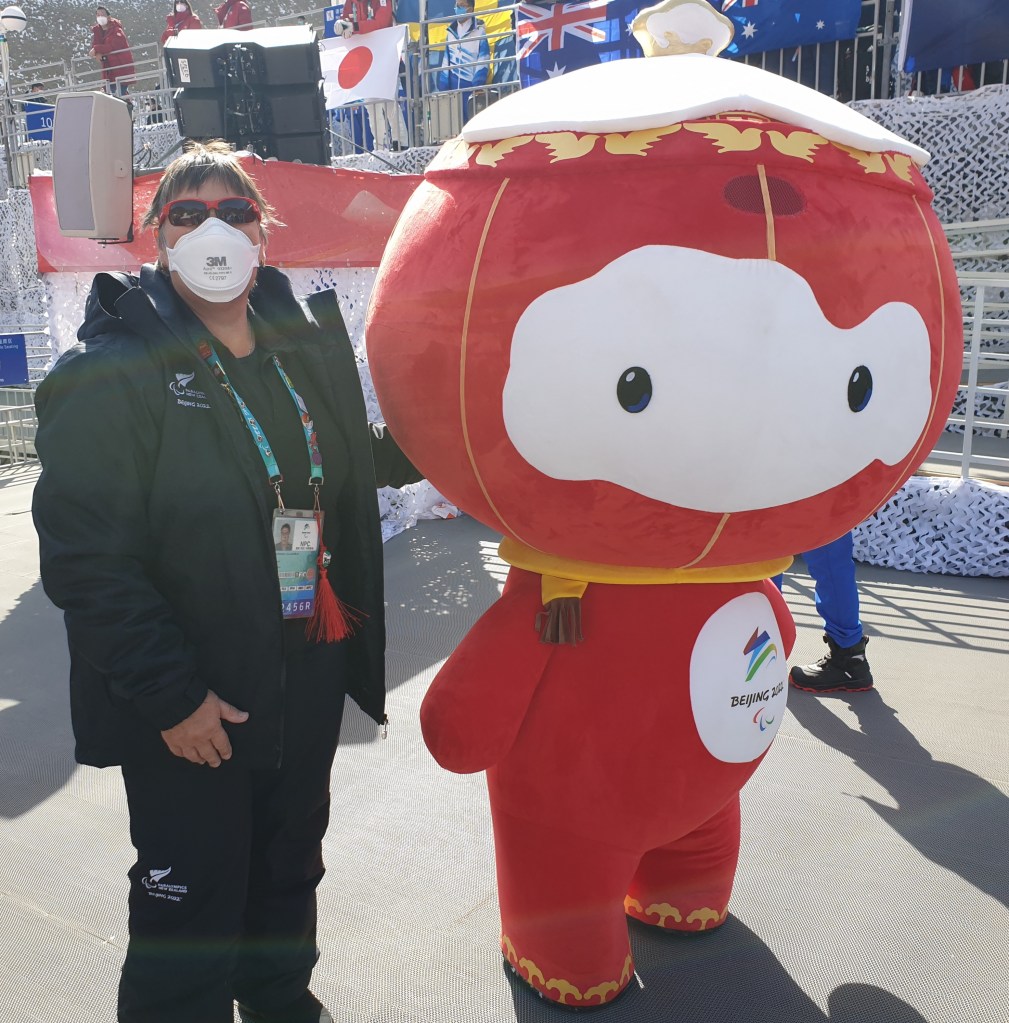
Hanging with Shuey Rhon Rhon in Beijing

I had the pleasure to represent Paralympics New Zealand at the 2022 Winter Paralympic Games in Beijing. Having missed the summer games in Tokyo this was an opportunity of a lifetime.

The NZ team consisted of 3 athletes – Paralympians Adam Hall #158 and Corey Peters #188, both of whom I watched racing at the 2018 Pyeongchang Games in South Korea, and debutant Aaron Ewen #288. What amazing performances from these three Para alpine skiers – Corey taking the top podium spot with a gold and a silver, and Adam coming home with 2 bronzes.

These games were not only memorable for the Covid-19 closed loop system meant athletes, teams and officials were isolated from the local communities which were hosting us – think MIQ supersized, but also for the change in world politics at the time with Russian invading the Ukraine. Sitting in NZ we are very fortunate to be immune from many of the global political issues faced by other countries which I think may have been lost on many of the protesters at Parliament who were still encamped on the front lawn when I departed for Beijing.

Travelling at this time was also surreal. Our team had clear Covid-19 protocols in place which meant we were seated separately from each other on the long flights and encouraged not to mingle with others. We all succeeded in getting to and from Beijing in good health with no one catching covid.

During my time in Yanjing, which is about 1 1/2hrs west of Beijing, close to the mountains where the alpine skiing was located, we experienced fine, sunny and clear but cold days (-6 not uncommon), hazy days when you couldn’t see the mountains and also an amazing sand storm which rolled in from the Gobi Desert, 1100km away, which still left sand on the ski slopes and a bit of damage down in the valley. These sort of events amaze me by just how much bigger everything in China is compared to little ole NZ.

Meeting Para athletes, coaches, officials and administrators from around the world was illustrative how large the Paralympic Movement is and how many passionate and committed people there are making sport happen at all levels in their countries.

It was such an honour to represent NZ and be part of the NZ delegation who are highly regarded and respected. Until next time, I’ll always remember Shuey Rhon Rhon as the face of the Games.

An historical analysis of disability sport policy in Aotearoa New Zealand

Abstract

The role of central government in disability sport in Aotearoa New Zealand has never been reviewed in depth. In this paper, drawing on archival data we outline the evolution of disability sport policy, highlighting key initiatives of government sport agencies from 1937 to the contemporary disability sport policy landscape. Evolving with the rise of the social model of disability, these policies are considered a necessary response to an historical invisibility of disabled people in sport. We highlight a landscape that is complicated by significant diffusion of power between government and ‘not-for-profit’ organisations responsible for the provision of sport for disabled people. Within this contested landscape
and with the historical weight of policy, disabled people in NZ continue to report exclusion, marginalisation and lower levels of participation, suggesting a disconnect between policy and its enactment. We introduce the concept of ‘enlightened ableism’ to illustrate that while progressive ideals are embedded in disability policy, there are still challenges
for achieving true inclusive practice. Furthermore, lessons learned from previous policy failures suggest that while the future of disability sport in NZ looks well placed to facilitate increased participation, it is worth questioning the extent to which ableism is structured into the fabric of disability sport.

Catriona McBean, Robert C. Townsend & Kirsten Petrie (2022): An historical
analysis of disability sport policy in Aotearoa New Zealand, International Journal of Sport Policy and Politics, DOI: 10.1080/19406940.2022.2052147


To link to this article: https://doi.org/10.1080/19406940.2022.2052147

Tokyo, I miss you

As I watch the Paralympics on multiple devices simultaneously from home, I lament not being in Tokyo myself. This games would have marked 20 years since I first experienced a Summer Paralympic Games, and nearly 40 years since I visited Tokyo.

At the Sydney 2000 games, I attended my first wheelchair rugby game. I recall being in The Dome hearing the ear-bleeding noise of the chairs crashing into each other as players attacked to get over the try line while the opposition blocked. Looking back at old photos the technology of the chairs has changed so much that I’m surprised these early athletes survived those collisions!

As a volunteer at a games – this would have been my third games following Pyeongchang 2018 Winter Paralympics and Rio2016 Olympics – I have been in the position to experience these games from a unique perspective. Behind the scenes so much happens to ensure the athletes have the best possible opportunity to excel and its a privilege to be part of it.

This year my role was to support one of the Pacific Island teams, for some it would have been their first games. For me too, it would have been the first time I would have worked directly with a team, rather than assisting with a sport. Unfortunately the pandemic has wrecked havoc with many of the teams’ unable to attend the games due to border closures and no flights. Hopefully Paris in 3 years time will bring this opportunity to these athletes and create a legacy for Para sport in their respective countries.

Thinking about legacy of Para sport, I have been exchanging emails with the IPC Vice President, a Kiwi who I know and respect highly. We’ve been talking about the use of the word impairment versus disability in relation to my research and whether there is a right or wrong way to describe athletes in sport. It’s made me start thinking more about a few things, always good to be challenged, thanks Duane.

The social model of disability describes disability as being imposed by society on an individual rather than the impairment itself being the disability. Disability comes from attitudes and behaviours of others, inaccessible facilities and amenities and a lack of considered support for individuals who do not meet the “norm” leading them to be unable (or disabled) to fully participate in society.

In my research, I am looking at young people with physical impairments who are actively engaged and are participating in sport, so the question I am now pondering is, are they disabled? If I stick with the social model, I could argue that in the context of sport they are not disabled, rather they are enabled. This is an interesting perspective I will now need to now consider more, especially how these young people themselves describe their experiences.

My interest is also piqued in how the label disability is attached to individuals. I’ve thought about this briefly and realise we all have multiple identities – parent, child, sibling, partner, friend, boss, colleague, team mate – all many different but most contextual. So now I’m thinking why are individuals labelled disabled as their singular and often only identity? Don’t all people have different relationships in different contexts?

So for the young people in my research who are actively participating in sport, can they be enabled in sport while being disabled in other spheres of their lives? Can I call them young people with impairments rather than disabled if the context is appropriate? Does this paradox mean the language, discourse and narrative around disability needs to become more flexible and contextual? Again, interesting questions which will require further contemplation and consideration.

Which leads me back to Tokyo. Watching these athletes from all over the world perform at the Paralympic Games under the banner of Para sport and Para athletes – being parallel to Olympic and Olympians – signals to me a change is happening. They are athletes first and foremost, they are competing at the highest level of their sport, and many are performing beyond perhaps even their expectations, as seem by the multitude of world records broken in the pool, at the velodrome and on the track. Wow, what a games it has been.

I do wish I was there, but I fully understand the decision made to limit the number of internationals attending the games. For now though, I will continue to watch as much as I can on all my devices. To all the athletes, coaches and officials on the field of play and everyone involved in all the hardwork behind the scenes which have made these games so successful, I say to you Hontoni arigato gozaimasu – Thank you so much. You are all, in your own way helping breakdown the barriers and making this world a better place for all to live.

Inclusive Sport – It’s not rocket science … but should it be?

Research Participants Still Needed

Last week while I was at the Halberg Games I looked around at all the young athletes participating and realised that the vast majority of them were unlikely to participate in sport outside of that delivered by their local regional disability sport organisations, such as dsport.

This is why I am doing my research, to try and make a better sport and active recreation future for our young people with impairments.

But, I still need help. To support my research I need more young people who are willing to tell me their stories about being included in able-bodied sport. I want to hear about those successes so we can share this information with other sports group and really start to make sport more inclusive in New Zealand.

So far I have interviewed 2 young people and their stories have been great. Not only have they shared what they find helpful, they have thought about how to make it better – and guess what, its not that difficult.

You know, we are involved in sport, not rocket science, so we don’t need to think they way the team does at Rocket Lab to make our ideas fly. Well actually, perhaps we do!

Peter and his team are all about “redefining how we access space”

Building on the “kiwi ingenuity” tradition, Rocket Lab has shaken up space travel – they’ve made it simpler, cheaper and easier to do. They are literally sending rockets into space from a grassy penninsula surrounded by sheep – launching satellites that help with communications, navigation, science and research, and imaging and surveying.

Rocket Lab was one man’s dream and he made it happen. Why can’t we in sport make lots of peoples dreams happen? There’s definitely more of us to help get disability sport inclusion off the ground. So why not help try?

How can you help?

If you are a young person aged 10-14 years with a physical impairment who is part of able-bodied sport, here is your opportunity.

Talk to your parents/caregivers and get them to nominate you.

A recruitment questionnaire has been designed to help me find 4 or 5 young people to be part of this research, but also help build a know base on young New Zealanders with physical impairments.

If you have any questions regarding my research, please feel free to contact me cm289@students.waikato.ac.nz.

The beginning of a reflective journey

Starting university research on a topic I have been so close to for many years is an interesting journey. During lockdown I was able to use this enforced time at home to read lots and lots of articles about disability sport. What is interesting is the increasing number of academics who are recognising this is an area worth of consideration. More and more research is being undertaken on disability sport and on children and young people.

Reflecting on this research is part of the process. Read, consider, critic and reflect. In reflecting on my experiences and what the research is saying is leading me to reconsider how we have been doing things here in New Zealand. We have a great country which is sport mad. People say sport is in our DNA. This is so true. We also have a country which is pretty open and welcoming. We are not as constrained as other countries by cultural mores which restrict sectors of society, but we still have a long way to go.

In terms of the sports system, should all sport be equal and considered in the same way? We are fully aware and accept individual and team sports require different considerations, and female-dominated sport and male-dominated sports have different priorities and pathways. So should “disability sport” be separate or the same? Isn’t sport just sport? I’m not sure if sports funders, governors and managers know how to address disability sport. Perhaps this is because just like our “team of five million”, disability sport as a collective noun is attempting to represent a dynamic and diverse, constantly changing population with a range of dreams and aspirations.

One of our biggest issues with progressing disability sport is getting young people with impairments into sport. How can this be done in a manner which provides opportunities which are positive and are quality experiences? I hope to find this out through my research. I have no answers, just questions. Lots of questions.

At some stage I will have to ask myself some hard questions. Working in the sector, does that mean I am perpetuating the status quo or creating solutions? Is what I am doing right or wrong? Are I am part of the problem? Hard but probably necessary, just not yet. That will be further along my journey. But for now, more reading, more considering and more critiquing. Fortunate I guess, spring’s unpredictable weather lends itself to staying inside and working…. summer, well that’s another story!

Welcome to “we’re not on the sideline, we are in the team”

In Aotearoa New Zealand disabled young people are under-represented in sport and active recreation.

Sport New Zealand (Sport NZ) acknowledges this issue and is working on developing policy to address it. I have worked in the disability sport sector for nearly a decade, and while I have observed disabled young people missing out, I have also seen some fully engaged in sport and active recreation.

Through hearing from these young people with physical impairments (YPwI) who are active and engaged, I want to find out how more opportunities can be provided to get more disabled young people involved in sport and active recreation.

Aligning with the Sport NZ priorities of tamariki and rangatahi, this research shall specifically engage YPwI aged 10 to 14 years who have either been born with or have acquired a physical or sensory impairment. Capturing participation information for this priority group may well support initiatives to slow the rapid decline in participation rates, providing some redress for disabled peoples engagement in sport and active recreation.

To this end, this research focuses on what contributes to the positive engagement of YPwI in sport and active recreation in Aotearoa New Zealand.