
Wellington sports charity helps rev up wheelchair rugby in Nepal
By Justin Wong, The Post (28 October 2024)
A Wellington-based disability sports charity is hoping to spark the revival of wheelchair rugby in Nepal after a magnitude 7.9 earthquake rocked the south Asian country almost a decade ago.
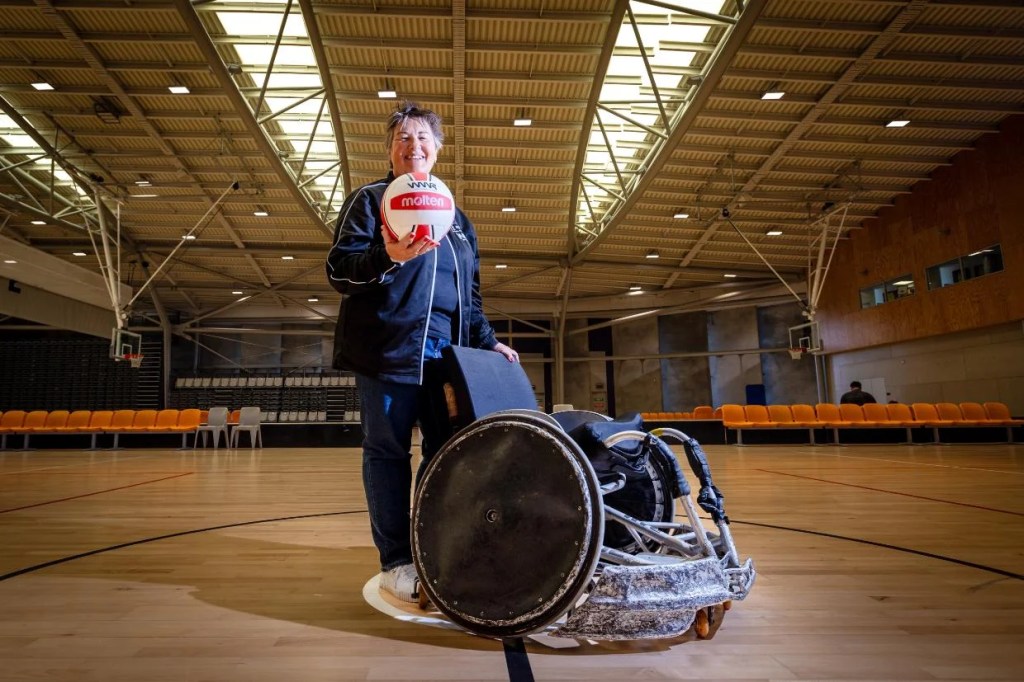
Dr Catriona McBean, the general manager of dsport, and a Paralympics New Zealand board member and New Zealand Wheelchair Rugby chairperson Dr Cherie Harris are heading to Kathmandu for a two week “fact-finding mission” at the invitation of Nepalese wheelchair rugby administrators.
“Sport is universal and it should be universal, and helping organisations identify how they can provide opportunities for their communities is quite a powerful experience to be part of,” McBean said.
The April 2015 earthquake, which triggered an avalanche in the Himalayas, was the south Asian country’s strongest shake in eight decades. It killed more than 8600 people, destroying infrastructure and thousands of houses.
Wheelchair rugby was played at a community level in Nepal before the earthquake, McBean said. Although the sport shared some similarities with wheelchair basketball – namely both play on an indoor court and involve wheelchairs – wheelchair rugby was an impact sport, and the custom-built chairs were more expensive because they needed to be heavier and sturdier.
In the years since the earthquake, Nepal had re-established wheelchair basketball, even hosting an international tournament with teams from nearby India and Bangladesh. The country remains one of the poorest in south Asia.
“We’re trying to take the opportunity to get a better understanding of the lay of the land and how we can possibly help in the future,” McBean said, hoping the Nepalese associations would be able to utilise their New Zealand counterparts’ networks to access more resources.
She and Harris would host workshops on topics such as strategic planning and community engagement, and look for long-term opportunities for Nepalese teams and players to get equipment.
Levelling the Playing Field
By William Sangster, Attitude Live (2023)
Catriona McBean has 20 years of experience in sport management. Currently on the board of Paralympics New Zealand, she recently completed her PhD in Disability Sport at the University of Waikato. She talks about her upbringing, her career, and the Paralympics. McBean also discusses her thesis, which details how disability sport is levelling the playing field.
What is the difference between `Disability Sport’ and `Sport’?
The answer is nothing. And if you have a problem with that, don’t argue the point with Catriona McBean.
“People who are involved in sport aren’t disabled; they are enabled if they are participating. I’d only use the term disabled to describe those who are not involved in sport because the sports system, rules and infrastructures prohibit participation.”
Catriona has 20 years of experience in sport and sport management. She has worked for Water Safety NZ, Swimming NZ, Sport and Exercise NZ, Orienteering NZ and dsport.
“Working in sport is a huge privilege. I have had the amazing opportunity to be part of and witness gold medal-winning and record-breaking world performances at the Paralympic and Olympic Games and World Championships. But for me, this isn’t my biggest highlight.”
“It may sound like a cliche, but for me, the biggest highlight is the power of sport to transform lives. It doesn’t matter if you are disabled or non-disabled, an elite athlete or a club player; your performances often defy your own beliefs. I have seen athletes, young and old, excel in their sport, bettering not only their own expectations but also redefining how they see themselves in the world.”
Catriona, who is currently on the board of Paralympics New Zealand, recently completed her PhD in Disability Sport at the University of Waikato. Her thesis was titled `I forget I have a disability: Understanding young people’s experiences in disability sport and active recreation in Aotearoa, New Zealand.’
Now, take note; it is important to state that Catriona McBean doesn’t have a disability.
“I am not disabled, nor was I a young person with an impairment.”
However, her father arguably did.
“Unbeknown to me as a child, my father could have chosen to identify as disabled, but he did not. Injuries sustained during WWII while a navigator in RAF Bomber Command left him wearing a caliper (now referred to as an ankle foot orthosis or AFO) and walking with a stick. His aspirations to represent NZ, wearing the silver fern, as a runner ceased. Always active, my father did not let this injury define who he was. My Dad taught me several life lessons strength through adversity, perseverance, and never giving up on your dream.”
So, why title her thesis `I forget I have a disability’?
“I chose this title as it was actually what one of the young people I interviewed said. It really made an impression on me. It totally described what sport meant to these young people.”
Catriona believes that being connected to sports can “transform lives”. Disability or not.
“Being part of a team, having a sense of belonging, being able to challenge yourself both physically and mentally – these are just some of what sport has to offer.”
“Disability sport is about equity. It provides opportunities for people to experience a sport which is better suited to their abilities. It also provides a more even playing field for comparing capability. It also provides a platform for education and understanding.”
Catriona is heavily involved in the Paralympic Movement in NZ and is looking forward to the Paris Paralympic Games.
“I am really, really excited about the upcoming Paralympic Games in Paris. It will be an amazing experience for everyone involved. I expect to see new athletes in Paris who will raise the bar on performances. Paralympic performances and records are now very, very competitive, and we’re fortunate in NZ to have athletes representing us who will be leading this charge.”
Catriona believes there’s a lot of room for improvement and that all sports in NZ can better serve the disability community.
“The low participation rates of disabled young people was first raised in Parliament in 1937. It’s now 85 years later and we still haven’t seen much change. But it is really time for change to happen.”
The priority is to get rid of ableism and discrimination in our sports system.
“The first step to getting rid of ableism and discrimination in our sport system is to recognise it actually exists in the first place. Most people do not recognise it. Unfortunately, sport is a reflection of society and as most disabled people will tell you, ableism and discrimination is inherent in everyday life too.”
“Being able to understand what it’s like to be disabled is difficult if you haven’t had any exposure to it. Trying to explain to someone who does not feel like their lives are limited or constrained is hard.”
She says change isn’t necessary or important – it’s imperative!
“I want to see more disabled people being treated with dignity and respect. Being included in the conversations when decisions that affect them are being made, being welcomed into sport and active recreation, being provided with all the same opportunities non-disabled people have without the need to fight for this right.”
What ticks her off in the community?
“Where do I start! One thing that really annoys me at the moment is those who are making decisions – be it in government or local government – do not consider disabled people. Often decisions are made to benefit a small minority but have a huge impact on the disabled community. But disabled people aren’t even thought about. When they are thought about, the consideration is often as an afterthought and sometimes quite patronising.
She points out an example when speaking with some decision-makers about streets in Wellington.
“They asked, ‘where do disabled people go?’ as if there was a single answer. My response was a bit blunt and pointed ‘Well, where do you go?’ Disabled people will go where they need to go to get what they want, visit where they want to. Just like you and I do, and this may differ each time”. So this continued belief that disabled people are different to non-disabled people across all aspects of their lives does tick me off.”
Catriona intends to keep paving the way for the next generation. She believes that we can all do something to level the playing field.
“Ask, don’t presume. Give disabled people the opportunity to have a voice and be part of any decision-making. One size doesn’t fit all. So don’t expect every disabled person to have the same needs and wants as others. You don’t expect this from non-disabled people, so why presume it for disabled people. Start, even if it’s just small changes; just make a start.”
As for the future, Catriona has a clear vision.
“That sport and active recreation in NZ is truly sport for all. That there will be no need for dedicated disability sport provision because there are no other options available. Rather, I’d like to see disability sports provided as one of many options and opportunities, so disabled people have a range of sports and activities to choose from.”

Practice what you preach
By Sonia Yee, NZ Institute of Directors Boardroom (Spring 2023)
What does it take to drive change and what kind of commitment does it take to make a difference? For those working in accessibility and disability-based sectors, shared values and purpose go hand in hand as the drivers in improving the lives, opportunities and outcomes of others.
Wellington-based Dr Catriona McBean CMInstD has spent her life’s work in the disabilities space, investigating the lived experiences of young people with impairments in sport and how their positive engagement can be used to facilitate increased opportunities for other disabled young people.
A sports, recreation and disability sports consultant, McBean is also the manager of dsport and sits on the board of Paralympics New Zealand.
“These are amazing organisations and my colleagues around the board table are an incredible group of people who come from all different areas of life, have diverse skill sets and experiences,” she says.
According to McBean, there is a noticeable difference with organisations committed to their purpose because they also value diversity at the table. “I’ve been on boards that haven’t been functional or diverse and have been quite focused on a singular outcome,” she says of the limitations this creates.
She believes a key to implementing shared values successfully across an organisation is to walk the talk. But that is where she also feels many organisations fall down.
“They’ll have policies and plans in place that say they want to be diverse and inclusive and represent the community. But when you look at the organisation, they don’t exhibit those traits in how the organisation is managed.”
The disconnection between what an organisation is saying and doing is not too dissimilar from greenwashing, she says. “I think people often don’t realise that it’s more than just saying that you have these shared values and it’s actually about putting those values into practice.”
Last year, McBean completed her PhD and while she has spent 30 years across sports management and disabilities, it was only in conducting her research and looking back through her own life that she realised how much her career path had been informed by her father’s disability.
An injury while working as a navigator for the RAF Bomber Command meant her father had to wear callipers and use a walking stick. “He couldn’t walk long distances and it was obvious when you saw him walking there was something wrong. But he never talked about any pain he was experiencing,” McBean says.
While she was aware of her father’s injury, she never perceived it as an issue. “I was quite a young child and it didn’t really dawn on me until 40-something years later that there was this connection to his injury, and that it had an influential impact on me,” she says.
Seeing improvements in the disabilities community and sport, in particular, is important in her work. She says sport, by its nature, is community focused and because of this dsport members are also very diverse.
McBean says one of the first hurdles in addressing shared values, especially around diversity and inclusion, is to overcome the fear of getting it wrong and boards should think about recruiting members who may have different impairments and experiences that can help inform an effective strategy.
“It’s thinking a bit more creatively about the various groups and communities out there that aren’t your traditional ones. . . we don’t need to contrive something different,” McBean says.
But if the organisation is struggling to find the right fit for the role, she says finding individuals who can champion the rights for those relevant communities is another way to gain traction in areas where change is needed.
“Whatever you do, you need to use words that ensure the message you’re giving is clear so people understand it, whether you’re trying to convey that to the board, to your staff, stakeholders, shareholders or your customers. You have to be clear they know what you’re talking about.”
“You need key people throughout the organisation to help champion the change you want to see, and it doesn’t always have to be a person with an impairment,” she says, adding that if there is a desire for change at the top, those people in the middle who can set aside some budget and get things moving can also be that champion.
For organisations to effectively foster awareness around the needs of disabled people within the workforce and the community, she says clarity is needed by the board to address what that looks like.
“Whatever you do, you need to use words that ensure the message you’re giving is clear so people understand it, whether you’re trying to convey that to the board, to your staff, stakeholders, shareholders or your customers. You have to be clear they know what you’re talking about.”
She suggests recruiters also look outside the traditional networks and parameters to find the right talent, including reaching out to Whaikaha – Ministry for Disabled People, the Disability Rights Commissioner, and exploring a range of industry sectors where people with lived experience may bring a valuable contribution, such as Paralympics New Zealand.
But creating change also means organisations need to look in the mirror to determine what barriers they might have in place that are keeping people from applying for roles or are detrimental to their desired diversity outcomes.
As an example, McBean says the question- sets in job application forms around disability can be confronting and create other hurdles or fear of discrimination. But she is quick to add these issues are part of a wider societal problem.
“That’s another barrier, another roadblock that people with impairments face on a daily basis and they aren’t being asked what they ‘can’ do.”
She says organisations need to figure out if they are after an outcome or looking for the right person to do the task. This approach requires reframing questions and thinking about different ways a task or role could be done.
“If you’re focused on an outcome, then the task can be done in many different ways. But if you’re looking at a task- focused perspective, you’re limiting how something can be achieved,” McBean says.
 We are in the team